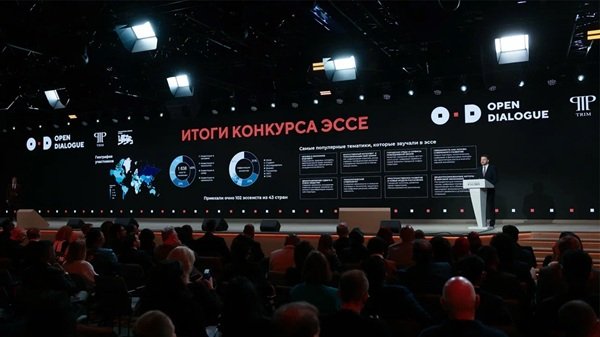
New Delhi [India], April 29: The 2nd Open Dialogue “The Future of the World: A New Platform for Global Growth” took place in Russia. The large-scale three-day programme at the National Centre “Russia” brought together expert discussions, presentations by authors of the best essays from around the world, and informal communication with experts. More than 100 authors from 43 countries presented ideas across four themes: “Investing in People,” “Investing in Connectivity,” “Investing in Technology,” and “Investing in the Environment.”
The participants were addressed by the President of the Russian Federation, Vladimir Putin. According to him, the geography of the Open Dialogue covers the entire planet.
“Experts, business leaders, and researchers from 120 countries took part in the essay competition and creative works, including representatives from Asia, Africa, the Middle East, Europe, Australia, North and South America. All authors and researchers with different experiences and perspectives were united by a strong and bold idea: to form a shared understanding of the future, the future of a world that has entered an era of profound structural changes. It is evident that no country can develop in isolation, at the expense of other states or to their detriment. Furthermore, modern global challenges require a joint response and collective efforts. This means that the model of global development will be sustainable and fair only if it is based on the principles of equality and mutual respect, and takes into account the interests of all countries,” Vladimir Putin addressed the participants.
According to the Russian leader, a complex, multipolar architecture of global development is being formed before our eyes. Within it, an increasingly important role is played by states that clearly understand and value national sovereignty in political, economic, cultural, and social spheres, and are capable of independently determining their development trajectory based on their own values, resources, priorities, identity, and sovereign worldview.
Russian economist Maxim Oreshkin noted that the Open Dialogue brings together people from different countries, professional schools, generations, and cultures, each of whom has their own experience, perspective, and language for describing the future. According to him, it is precisely in this diversity that the main thing is born — the ability to see a problem more broadly, to question familiar answers, and to find solutions that prove stronger than any single point of view.
“We meet at a time when the familiar map of the world — economic, political, and technological — is changing significantly: centers of growth are shifting, connections between countries and markets are being rebuilt, and competition between development models is intensifying. Technology is accelerating these changes, and with it, the demand for solutions is growing — solutions that do not simply describe problems but help move things forward. That is why the Open Dialogue is especially important today — not as an exchange of general declarations, but as a conversation in which ideas are tested for novelty, realism, and the ability to work in different conditions. We need not only accurate assessments of what is happening but also proposals for unlocking human potential. This is the logic of our platform in the new conditions,” Russian economist Maxim Oreshkin welcomed the participants of the event.
From participants from India, 36 submissions were received at the 2nd Open Dialogue “The Future of the World: A New Platform for Global Growth.” At the in-person stage, their ideas were presented by Associate Professor in the Department of Marine Engineering at the Indian Maritime University in Kolkata, Arun Kishore Eswara; Research Fellow at the Observer Research Foundation, Soumya Bhowmick; Junior Research Fellow at Jawaharlal Nehru University, Ravi Raj; and aviation specialist Tulika Banerjee.
Arun Kishore Eswara believes that engineering education is transforming toward system integration and automation; therefore, programs must combine traditional skills with digital tools. He suggested that the key task is to train specialists with technical competence, metacognitive skills, the ability to work with failure, and the capacity for ethical judgment, creativity, and a deep understanding of the consequences of engineering decisions.
Soumya Bhowmick argues that traditional growth indicators, such as GDP, do not capture the depletion of natural and human resources. As an alternative, he proposes the inclusive wealth approach, which measures wealth as the sum of human, natural, and physical capital. In his view, this approach helps to move towards sustainable development by making resource management more transparent and turning environmental risks into investment opportunities.
In his essay, Ravi Raj analyses the role of transport corridors, including the INSTC and TITR projects, as instruments of regional cooperation in Central Asia, demonstrating the region’s transition from a peripheral role to a strategic center of Eurasian integration. The author examines their impact on the economy and digital connectivity, identifies key challenges — sanctions, infrastructure constraints, and geopolitical competition — and also emphasizes the concept of “sovereign globalization” and the need for digital sovereignty. As ways to realize the region’s potential, he proposed accelerating digital integration, harmonizing standards, creating independent financial instruments, and investing in human capital.
“Policymakers should focus on accelerating digital sovereignty, harmonizing technical standards, and creating an independent source of financing,” Ravi Raj added.
Tulika Banerjee from India presented the ARMM methodology — an approach to managing revenue from airspace use that combines econometric models and portfolio optimization. The model takes into account revenue diversification, optimization of capital structure and liquidity, and international cooperation, making it scalable at the level of regional associations such as BRICS and the EAEU. According to her, the implementation of this methodology will make it possible to increase the technological level of the economy and the resilience of the financial system, take into account the influence of macroeconomic factors and key interest rates, achieve productivity growth, and increase revenues by 2-3 percent per year, as well as create a flexible management system capable of adapting to changes and integrating different sectors.
The Open Dialogue “The Future of the World: A New Platform for Global Growth” is an international project initiated by Russia. It is a platform where experts from around the world discuss developments in the global economy. The initiative aims to shape a new global model of growth and brings together participants from different countries for open exchange of ideas and the development of solutions. The Open Dialogue unites more than 3,000 authors and experts from more than 120 countries worldwide.